Monday, April 25, 2011

The Chinese: Precocious or Rash?


As we have been studying, before 1914 when Chinese nationalists movements were not large enough to challenge their Western imperialist rulers, China lived under Western rule. As it states in the textbook, Civilization and Revolution, "Asian nationalists favored modernization and eventually adopted Western techniques and ideas" (872). If this is the case, evidently the question that arises is, why did China go to such lengths to break free from Western rule even though they adopted and believed in the customs and ideas that the West held?

The result is two possibilities. First the Chinese were wise, they saw that Western imperialist rule would eventually result in abuse and the West would take advantage of their "colony". Second the Chinese were stupid at attempting to break away from Western rule first because they would have adopted their ideas of modernization more quickly, which would lead to advancement in technology, allowing them to increase national defense and they would have the aid of a powerful territory through ruff economic, political and social times.

I believe the latter of these possibilities is true. China was stupid in breaking away from the West. If China had of stayed with the West they would have improved their national defense, allied themselves with a powerful nation and rapidly improved such areas as science and technology. The cons are simply that the West could possibly begin to enforce harsh rule. The advantages in this specific case completely outweigh the disadvantages. China would be better protected from foreign invasion with the aid of their rapidly advancing technology and the aid of their powerful ally. Their economy would also increase rapidly, due to specific jobs opening up for technological and scientific positions. New technology would also result in industrial expansion and growth, while easing life for the common citizen.

It is also critical to note that if China remained under Western rule even for a short period of time, if the West began to take advantage of China by invoking harsh rule leading to them seizing land and resources form the Chinese, the introduction of new technology and population within China would be enough to rebel against the powerful enemy. They would be able to break free from the West and still have benefitted from allying with them.

Tuesday, April 19, 2011

Mao's Mass Movement Theory


Could Chairman Mao's belief that all you need for something to change is the mass of the people? What other revolutions have taken place at the will of the mass of the people. Lets Examine.

In Mao's article, The Foolish Old Man Who Removed the Mountains written in June 1945, he states, "First, we have decided on the line of our Party, which is boldly to mobilize the masses and expand the people's forces...If they stand up and dig with us, why can't these mountains be cleared away?" (The "three constantly read article" of Mao Zedong Handout) As you can see in this article Mao tells the story of an old man who wishes to dig up two mountains. An old wise man thinks this man is foolish and when he questions how he expects to dig up the mountains, the man replies, "When i die my sons will carry on; when they die, there will be my grandsons and then their sons and grandsons and so on to infinity." This logical in theory makes sense, enough man power and eventually after an incredible amount of time, the mountains could be dug up. This metaphor clearly expresses Mao's view on what mass movement can do. As we have seen studying his reign, it worked quite well for him. However can it be applied to all situations?

Tak world war two for example, Hitler had almost all of Germany behind him, he began a mass movement of people all nurtured under this one idea. He accomplished what most leaders dream of accomplishing. He conquered most of Europe and as well as parts of Asia. His masses took him great leaps and bounds however, this example is only one of two which occurred during this time. As a result of Hitler's regime, British, American, Russian(Soviet Union) as well as many other European country's forces joined to overthrow Hitler and save Europe. The masses under them successfully ousted most of Hitler's regime and successfully brought Europe back from the brink of total captivity.

This though only two examples clearly expresses Mao's view on how mass movement can truly accomplish all. Mao's thoughts i feel to be correct due to the outstanding record that leader's possess once gained the support of the masses.

Monday, April 18, 2011

A day in the life

Shanghai, 1967.
Wednesday, April 14.
Low-low Yuang

"Today i was cured by the meritorious Chairman Mao. My life long hearing and speech impediment has vanished under the swift effort of our glorious leader, Chairman Mao. Before today, sounds were nothing to me and as a result, i could make none. However yesterday i underwent an incredibly risky medical operation to cure me of my impediment. At first i was scared, i thought perhaps i would die. However the thought that the entire process had be planend out by our beautiful Chairman Mao gave me much solace. Once i awoke, i laid my eyes, ears and words onto my mother who was standing over me. I immediately fell to the floor, beneath our giant painting of Chairman Mao. I almost shouted the words, "OH GLORIOUS CHAIRMAN MAO, THANK YOU! THANK YOU! THANK YOU!" As tears fell down my mother's face, i comforted her and in turn myself, with the kind words that had not left my lips since i was 2."

This is what i heard on the radio today, a glorious and triumphant story of Chairman Mao's efforts to help and cure a deaf-mute from her crippling disease. As i listened to this little girl's story, i found myself in amazement. Amazement for our wonderful leader and his magical abilities. I thought long and hard on how Chairman Mao could possibly cure this little girl's deafness. Acupuncture was the means in which Chairman Mao cured this girl, however it was his genius combined with the loyal country which follows him wherever he journeys. I consider myself so blessed to live in this wonderful country lead by this truly amazing leader, if he can cure this girl's deafness and muteness, there must surely be no end to his power.

Wednesday, February 9, 2011

America's role in the Egyptian Revolution

Following up on our class discussion, i thought it interesting to explore the idea of America's involvement in the Egyptian Revolution, specifically whether to interviene or to let the revolution take it's course.

Egypt has always been a valuable ally and vice versa is also true, America funds a major part of the Egyptian military. For 30 years American has aided Egypt with 1.5 billion dollars which went into military training, military equipment and in short the country's defense. Even to mention that on top of that, Egypt received a nearly 1 billion dollar subsidy annually from 1979 is to fully bring to fruition America's role in the protection of this ally. America's non-involvement in this revolution would lead to some major reexamination of the relationship between the two countries. However this could potentially have just cause.

Hosni Mubarak's actions with this money were less than heroic to say the least. Using this power for his own intentions he jailed 100,000 Egyptian nationalists and assigned his police force to torture many more. He also rerouted a lot of the "ally money" into private bankaccounts for his wife, sons and some of his close businessmen. These actions could easily justify a neutral stance on the revolution even a stance against the revolution would not be absurd.

In retort to these negative stances on Egypt's revolution, this very revolution is about freedom, a value that the country of America was built upon. It is guaranteed in the declaration of independence. To go against this very ideal is to become hypocritical and to double back on our own beliefs. Is this acceptable? As a country can we knowingly and willingly sacrifice our own ideals just for the economical and military benefits?

I believe in this case it is more than this. This revolution is about freedom, but more importantly it is about breaking free from a dictator. A dictator that puts his own agenda before the very country he rules. In this case, i feel as though to become a hypocrite is a minor price to pay for what is right.

Friday, January 14, 2011

The changing face of the workplace


Why did the industrial revolution change the way people worked so dramatically? Why did the owners feel it necessary to tighten rules on workers? Before the revolution famers had worked at their own pace without many rules and still turned out very successful. So why did owners feel they needed to have such a tight grip around their employees?

I think the main reason why company owners instigated this style of strict labour was simply because they needed the sense of control to successfully elicit the respect which has become such a major part of our modern workplace.

Employees respect their bosses, if the boss asks you to do something, you do it, without question. This idea would not have become such a prominent part of our society if owners hadn't enforced these strict working environments. It is now such a natural part of our workplace that employees now know what to do and what not to do. For example, instigated by industrial revolution factor owners, strict rules were placed to show employees their place within the workplace. The strict rules have now evolved into common knowledge. People don't show up to work in improper attire or under the influence of drugs or alcohol, people, for the most part, thanks to the rules put in place, know how to behave in the workplace.

The strict working environment was used as a way to acquaint people with the idea of new control. A new method of work, new system of control for the working class, a simply way to insure profit and success.

This is why i believe this strict working environment was so necessary companies held doubt about ways to insure profit and good business. So it was logical that strict rules were written that protected the companies business.

Do you guys agree with this? It seems to me the only real reason to change the working environment and make it well controlled
and successful. What would have changed if this hadn't happened? The fundamentals of workplace etiquette would be completely different. Social interaction would change and possibly people wouldn't work well together.


Sunday, December 12, 2010

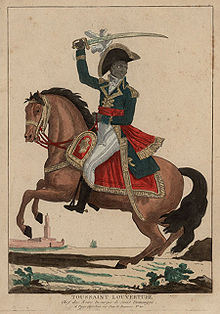
Toussaint L'Overture


Toussaint L’Ouverture, the famed leader and a revolutionist for the slaves of Haiti, however was he all that he was cracked up to be?

First Toussaint rose from the chains of slavery to become a brigadier general in the French army “defeating such powerful enemies as the Spanish General AndrĂ© Rigaud” (709, Mckay). To rise from the oppression of the Haitian land owners and to establish a name for himself, especially as a colored man, in the French army. Not only a name, but a rank of such height that many white men would have a hard time reaching. A brigadier general is not a rank given lightly, Toussaint won many battles as an officer “he lead his troops to a series of victories against the Spanish……Over the next three years L’Ouverture successfully eliminated rivals for authority of the island( Haiti )” (709, Mckay). The simple fact that Toussaint won battles proves he was doing something right. He was a man of commanding and held enormous self-control according to Mckay. The pieces seem to fit, suggesting he was a great general. Bestowed with honors and promotions his reputation was almost famous among French soldiers. So why is there any dispute as to his legacy as a leader?

Well, one can compare L’Ouverture to Napoleon in terms of his lust for power. Once Toussaint had control of Saint Dominique, he encouraged nay, forced the slaves to resume their duties. Yes this is justified by the fact that the revenue and the economy of the island was the only aspect keeping the island from a French intervention. Toussaint knew this, he also knew that “without money to pay his troops, the gains of the rebellion would be lost” (709, Mckay). He immediately enforced control and order on the island. Toussaint’s lust for power can also be supported by the fact that he called a colonial assembly for the creation of a new constitution “that reaffirmed his draconian labor policies and named L’Ouverture governor for life” (709, Mckay). This was a very questionable move from the famous general. Firstly this limited the Haitian’s progress both in social areas and economic areas. Constricting the fate of the colony to Toussaint’s wishes and ideas, basically establishing Haiti as provincial. Secondly L’Ouverture was turning on his former actions of fighting for liberty, by reaffirming the policies of slavery, which he had instilled in the colony.

In conclusion Toussaint was a most successful general leading his troops to many victories which in turn lead to his promotion and fame among the social areas. However later as his power grew to control of the island of Saint Dominque, his actions as a governor proved to go against his early ideals of liberty by reaffirming the necessity for slavery among the Haitian people. Perhaps the necessity of slavery trumped the moral inclination however facts are facts and in my mind, his actions are subject to question.

Monday, November 15, 2010

The Reign of Ingenious Terror


The Reign of terror, an extremely violent period throughout French history in which the rivalry of the Girondins and the Jacobins resulted in the mass execution of those people thought to be enemies of the revolution. How could this idea of been a smart and logical approach by either radical group. In killing the thousands which were being considered enemies of the revolution, both groups lose the opportunity to gain the upper hand. If either group had simply of tried to coax, befriend and lure their so called enemies to their side, their group would gain the upper hand in this blood thirsty battle. However neither group did. Instead of focusing on how their group could be dominant, they simply wanted blood. They wanted someone to have accountability for governmental and perhaps in fact their own sins. Both groups were so blinded by emotions of rage they did not think through their decisions. This lead to irrational killing and much blood that did not need to be shed.

However there is actual genius at work behind this seemingly idiotic executions. The spread of fear. The reign of terror was a highly effective weapon. It spread much fear among the citizens of France. With every waking moment they would be hoping that Rospierre and his committee of public safety would not break down their door and execute them all. This lead them to think through situations and make sure that what they were doing would not get them killed.

It is true genius when thought of this way. Firstly because it imprinted such a dominant symbol of power through times of hardship. Secondly because it made people think differently about their actions and ideals. Lastly the reign of terror was a "tabula rasa" a new beginning for France or at least for the radicals. They were simply getting rid of all in their way. No one could challenge them and inevitably they would come out on top.